
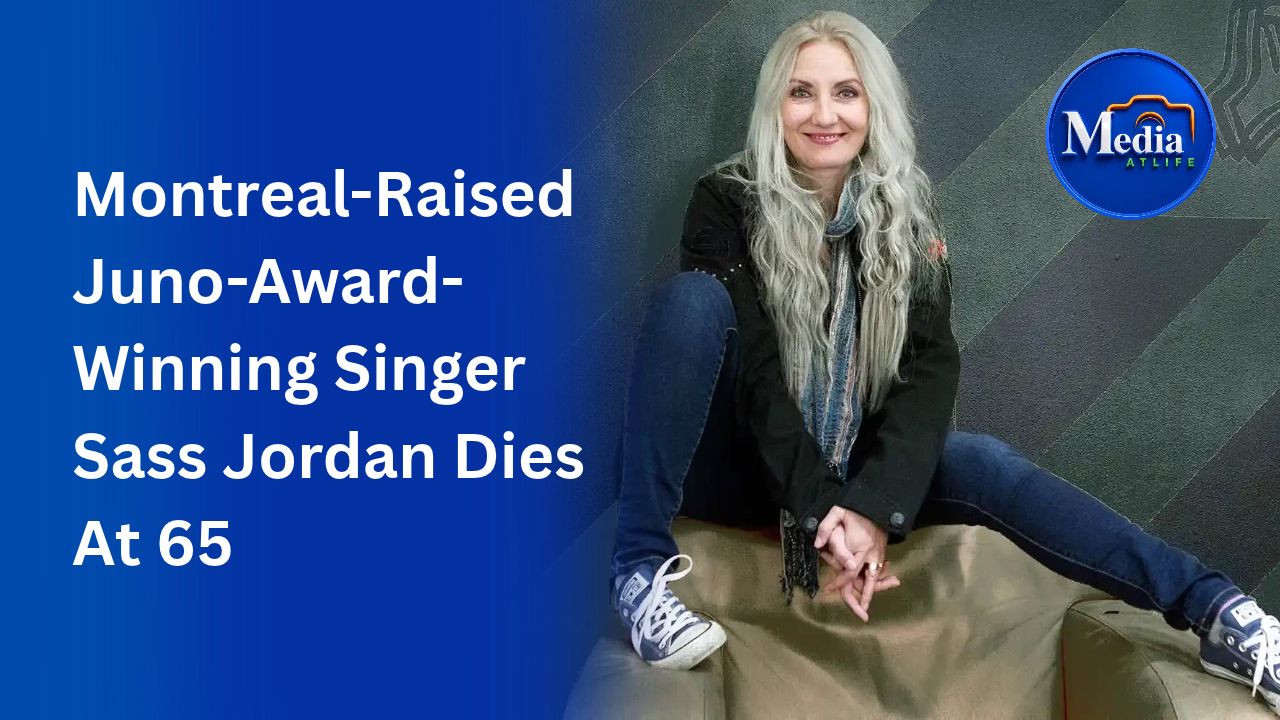
There are voices you hear once and never forget, and Sass Jordan’s was one of them. That gritty, soulful rasp carried Canadian rock through the late 1980s and ’90s, turned “Make You a Believer” into a radio staple, and later found a second life guiding a generation of hopefuls through their own musical journeys on Canadian Idol. On October 2, 2026, that voice went quiet for good. Jordan died peacefully at 65, surrounded by her family, closing out a career that spanned nearly four decades and left an unmistakable mark on Canadian music.
Her family confirmed the news in a statement shared by CTV News, describing her as someone who had peacefully crossed over surrounded by the people who loved her most. No cause of death has been released publicly, and her family has asked for privacy while they grieve. What they did share, though, captured exactly who she was to the people closest to her — an irreplaceable force of light, warmth, and joy.
From Birmingham To Westmount Park
Sass Jordan’s story didn’t start in Montreal, even though the city shaped nearly everything about who she became as an artist. She was born Sarah Jordan on December 23, 1960, in Birmingham, England, the daughter of a French literature professor and a former English ballerina. While she was still a young child, her family relocated from England to Montreal after her father accepted a professorship at Concordia University, and that move ended up changing the entire trajectory of her life.
Montreal in the 1970s had a thriving, scrappy local music scene, and Jordan found her way into it early. As a young teenager, she started singing and playing guitar with friends in Westmount Park, the kind of casual, low-stakes beginning that so many great musicians share. But Jordan didn’t stay casual for long. By the time she was 16, she was already fronting bands in downtown Montreal’s club circuit, cutting her teeth in rooms full of strangers long before most people her age had figured out what they wanted to do with their lives.
That early immersion led her to The Pinups, a well-regarded local band where she served as both singer and bassist. It was the kind of grounding most musicians spend years trying to find — real stage experience, a real local following, and a voice that was clearly built for something bigger than the Montreal club scene alone.
The Breakthrough That Put Canada On Notice
Jordan’s recording career properly launched in 1988 with her debut album, Tell Somebody, released on Atlantic Records. The lead single of the same name became a fixture on Much Music, Canada’s dominant music video channel at the time, and it introduced the country to a singer who sounded like nobody else on the airwaves — a voice that could growl through a blues riff one moment and soar through a rock anthem the next.
Latest





The industry noticed almost immediately. In 1989, Jordan won the Juno Award for Most Promising Female Vocalist of the Year, a category that’s since been rebranded as Breakthrough Artist of the Year. It was the kind of early validation that can make or break a young artist’s confidence, and for Jordan, it was clearly the former. She followed that win with Best Female Vocalist nominations in 1990, 1993, and 1995, cementing her place as one of the most consistently respected voices in Canadian rock across an entire decade.
Her second album, Racine, arrived in 1992 and became the project most fans still associate her with today. It included “Make You a Believer,” the song that remains her signature hit and the one most likely to come up whenever her name is mentioned on Canadian radio. That same year, she recorded the duet “Trust in Me” with Jeff Healey, another towering figure in Canadian blues-rock, pairing two of the country’s most distinctive voices on a single track.
Jordan kept recording through the 1990s, and her 1994 material delivered her first appearance on the Billboard Hot 100 with the single “Sun’s Gonna Rise,” a genuine milestone for a Canadian rock artist trying to break through south of the border. Her discography continued to grow from there, eventually closing with a live record, Live in New York Ninety-Four, a fitting final chapter for an artist whose live performances were often described as even more electric than her studio work.
Sharing Stages With Rock Royalty
Part of what made Jordan such a respected figure within the industry, beyond her chart success, was the company she kept on tour. Over the course of her career, she opened for and performed alongside some of the biggest acts in rock history — Aerosmith, AC/DC, Van Halen, and the Rolling Stones among them. That’s not a lineup any artist ends up next to by accident. It takes a specific kind of stage presence and vocal power to hold your own opening for bands operating at that scale, and by every account, Jordan did exactly that, night after night.
There’s also a quieter but genuinely remarkable piece of her legacy that doesn’t always make the headlines: Jordan played a real role in shaping the early career of Taylor Hawkins, who would go on to become the longtime drummer for Foo Fighters before his own death in 2022. Hawkins got some of his earliest professional experience playing in Jordan’s touring band, and he spoke warmly over the years about what he learned from her as a performer. It’s the kind of mentorship that rarely gets its own headline but ends up rippling through an entire generation of musicians who came after.
The Canadian Idol Years
For a huge swath of Canadians who weren’t around for Jordan’s chart-topping years in the late ’80s and early ’90s, she became a household name through an entirely different medium — television. Jordan served as a judge on Canadian Idol for all six seasons of the show’s original run, sitting alongside the panel that helped launch the careers of Canadian singers who grew up idolizing exactly the kind of artist she’d been decades earlier.
That role did something important for her legacy. It introduced Jordan to a younger generation who had no context for Racine or Tell Somebody, but who came to know her as the sharp, no-nonsense judge with real rock-and-roll credibility behind every piece of advice she gave. Unlike some reality show panelists whose authority feels manufactured for television, Jordan’s critiques carried the weight of someone who had actually lived the career her contestants were chasing — the club gigs, the grueling tours, the long climb from Westmount Park to the Billboard charts. That authenticity came through on screen, and it’s a huge part of why so many former Canadian Idol contestants have spoken warmly about her guidance in the days since her death was announced.
A Health Scare That Hinted Something Was Wrong
Looking back, there were signs in the weeks before Jordan’s death that something serious was happening. In September 2026, she canceled a set of scheduled tour dates across Ontario, citing a medical issue without going into further detail at the time. She had still been scheduled to perform at a fundraiser in Calgary that November, which suggests the full scope of what she was facing may not have been clear even to her closest circle until very close to the end.
That kind of timeline — an artist still planning future shows just weeks before passing — is a reminder of how suddenly illness can escalate, and it’s part of why the news of her death landed as such a shock for fans who’d been following her social media right up until the cancellation announcement. Her family has not released an official cause of death, and out of respect for their wishes, most outlets covering the story have left that detail alone entirely.
The Tributes Have Been Pouring In
In the days since her family’s announcement, tributes have come from across the Canadian music industry and beyond. Fellow musicians, former Canadian Idol colleagues, and fans who grew up on her music have flooded social media with memories of her voice, her generosity as a mentor, and the sheer force of personality she brought to every room she walked into. Longtime music publicist Eric Alper, who worked within Canadian music circles for years, spoke about her legacy, describing a catalogue that shaped Canadian rock through two full decades and a blues sensibility that only grew richer with each record she released.
Industry trade outlets have echoed similar sentiment. Billboard’s coverage of her death emphasized just how platinum-selling and genuinely influential her career was, not just as a chart presence but as a performer who left a lasting imprint on everyone who shared a stage or a studio with her. That sentiment has been echoed across music press worldwide, with outlets like Blabbermouth running detailed tributes covering her full career arc, from those early Westmount Park beginnings all the way through to her final recordings.
Survived By Family Who Shared Her Life On The Road And Off It
Jordan is survived by her husband, musician Derek Sharp, her daughter Stella Jordan-Sharp, her stepdaughter Brianne Sharp, and her brother Daniel Jordan. Hers was a life that, by every account, blended a demanding, high-profile touring career with a genuine, grounded family life away from the stage — not always an easy balance for someone whose career required months on the road sharing stages with some of rock’s biggest names.
Her family’s statement captured that duality well, describing someone who was simultaneously a towering musical presence and, within her own circle, simply beloved — a woman who could headline a tour one year and sit quietly holding a cat in a family photo the next. That image, shared alongside the announcement of her passing, has become one of the most circulated tributes to her since the news broke, precisely because it captures something the industry coverage alone can’t: who she actually was when the lights went down and the tour bus pulled away.
What Her Legacy Actually Looks Like
It’s worth stepping back and thinking about what Jordan actually built over nearly four decades in the public eye, because it’s easy to reduce a career like hers down to a single hit song or a single television role. The truth is more layered than that. She was part of the generation of Canadian rock artists who proved the country’s music scene could produce voices that stood toe-to-toe with the biggest acts in the world, touring alongside legends rather than simply admiring them from a distance. She was a Juno winner whose early acclaim held up across an entire career rather than fading after one big year. She mentored a future Foo Fighter before anyone knew that mentorship would matter. And she spent six full seasons helping shape the next generation of Canadian vocalists on national television, bringing real credibility to a format that doesn’t always earn it.
That’s a rare combination — chart success, critical respect, genuine mentorship, and a second act in television that actually added to her legacy rather than diluting it. A lot of artists get one or two of those. Jordan built all four, over the course of a career that started in a Montreal park with a borrowed guitar and ended with a catalogue that shaped an entire genre in her home country.
Why Her Early Years In Montreal Mattered So Much
It’s tempting to treat an artist’s childhood as background trivia, a few sentences to get through before the “real” story of fame begins. But in Jordan’s case, those early Montreal years explain almost everything about the performer she became. This was a kid born in England to a French literature professor and a former ballerina, transplanted to a French-speaking Canadian city as a small child, growing up in a household shaped by art and academia rather than rock and roll. And yet by sixteen, she was already fronting bands in some of the roughest, most unglamorous club rooms downtown Montreal had to offer.
That contrast — refined upbringing, raw musical instinct — shows up all over her later work. Jordan’s voice was never polished in the way a classically trained vocalist’s might be. It was lived-in, scraped-up, full of grain and grit, the kind of voice that sounds like it was earned in smoky club basements rather than practiced in front of a mirror. Westmount Park, where she first picked up a guitar with friends as a young teenager, sits in one of Montreal’s more affluent neighborhoods — which makes the trajectory that followed, from a park bench to The Pinups to Atlantic Records, feel even more like a story of someone chasing a sound rather than chasing a lifestyle.
The Pinups gave her something that can’t be manufactured by a record label: real stage mileage. By the time major labels came calling, Jordan wasn’t a studio creation being taught how to perform. She was already a seasoned frontwoman who’d spent years commanding a room, and that experience is audible on every one of her early recordings.
The Sound That Defined A Generation Of Canadian Rock Radio
To understand why Tell Somebody made the splash it did in 1988, it helps to remember what Canadian rock radio actually sounded like at the time. The late ’80s were crowded with big, polished arena-rock productions, and Jordan’s debut cut through that landscape by sounding rawer, bluesier, and more emotionally direct than most of what was getting airplay. Much Music’s heavy rotation of the “Tell Somebody” video wasn’t an accident of timing — it reflected a genuine hunger for something that felt less manufactured.
That same instinct carried through Racine four years later. “Make You a Believer” didn’t chase trends; it leaned into exactly what had made Jordan distinctive in the first place; a voice that could hit a note with real force rather than studio-smoothed perfection. The duet with Jeff Healey that same year, “Trust in Me,” paired two of Canada’s most soulful voices on a single track, and it’s still held up by fans and critics alike as one of the most memorable collaborations of that era in Canadian music.
By the mid-’90s, when “Sun’s Gonna Rise” became her first entry on the Billboard Hot 100, Jordan had firmly established herself as one of the few Canadian rock artists of her generation capable of building a following on both sides of the border without sacrificing the rawness that made her stand out in the first place.
A Career Built On Longevity, Not Just A Single Moment
One of the more underappreciated aspects of Jordan’s career is simply how long she stayed relevant and active. A lot of artists who break through with a strong debut album find it difficult to sustain that momentum across decades, especially once musical trends shift. Jordan’s path looked different. Her Juno nominations stretched across 1990, 1993, and 1995 — not a single flash of acclaim, but sustained industry recognition across half a decade. Her touring career, which included dates alongside Aerosmith, AC/DC, Van Halen, and the Rolling Stones, continued well beyond her initial chart success, built on a live reputation that reportedly only grew stronger with time.
And then, rather than fading into nostalgia-circuit territory the way some rock artists of her era eventually did, Jordan found an entirely new audience through Canadian Idol, reinventing her public role without abandoning what made her credible in the first place. That’s a genuinely difficult pivot to execute well. Plenty of musicians who move into television judging roles end up remembered primarily for the television work, with their actual musical legacy fading into the background. Jordan managed to do both at once — the Idol years introduced her to new fans while her existing catalogue kept finding new listeners through radio and streaming.
Even in her final creative chapter, she stayed active and engaged with live performance, which is part of what makes the September 2026 tour cancellation and her death just weeks later feel especially sudden to the people who’d been following her.
Remembering The Voice
If you want a sense of who Sass Jordan was as a performer, the best place to start is still Racine, and specifically “Make You a Believer,” the song that remains her most enduring piece of work. It’s rock built around real vocal power rather than studio polish, the kind of track that makes it obvious within the first ten seconds why she was being compared to the biggest names in the genre. For anyone discovering her for the first time through this news, that album is the right place to begin.
For longtime fans, the loss is more personal. This was the voice that soundtracked a specific era of Canadian radio, the judge whose feedback actually meant something on Canadian Idol, and the performer whose live shows reportedly hit even harder than her studio recordings. Her family has asked for privacy during this time, and the broader music community has largely respected that, choosing instead to let the tributes speak for themselves — a wave of remembrance from fans, fellow musicians, and industry figures who all seem to be saying some version of the same thing: Canadian rock sounded different because Sass Jordan was part of it, and it won’t sound quite the same without her.
Rest in peace, Sass Jordan. December 23, 1960 — October 2, 2026.