

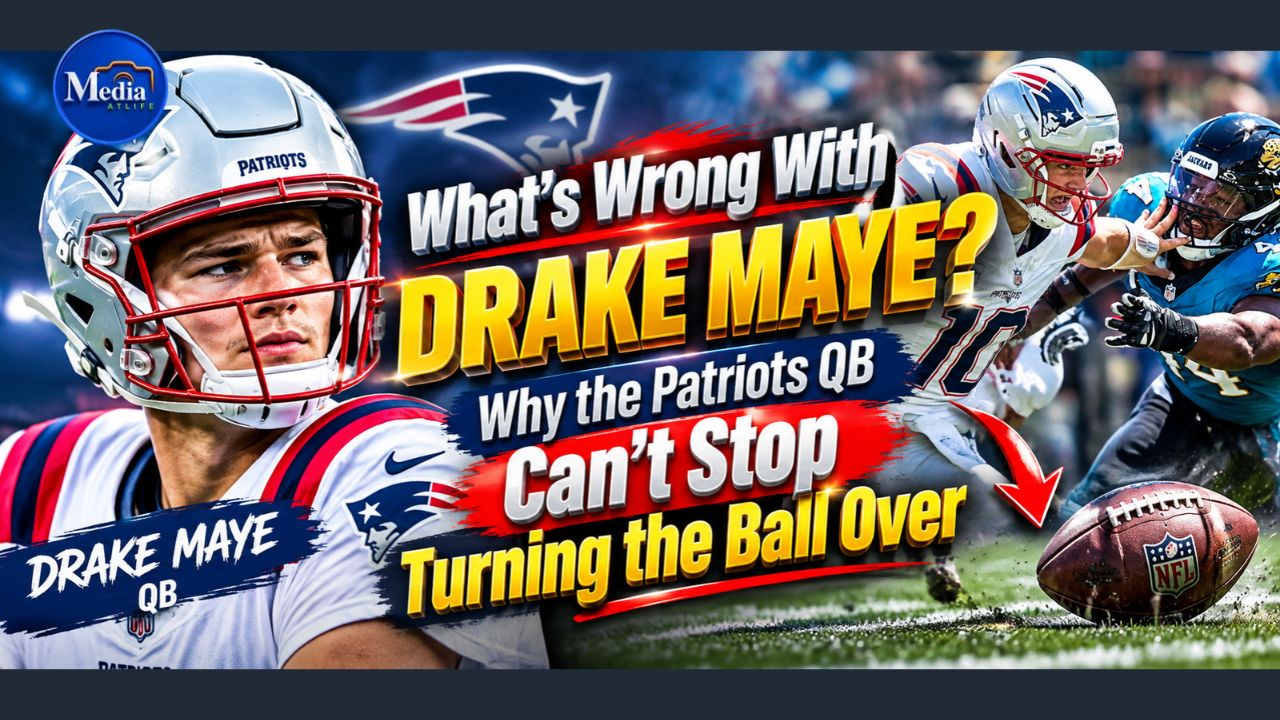
What’s Wrong With Drake Maye? Why the Patriots QB Can’t Stop Turning the Ball Over
Three games into the 2026 season, the story around Drake Maye has flipped almost completely. A year ago he was the breakout star who nearly won MVP and dragged New England all the way to the Super Bowl. Now he’s the quarterback leading the league in interceptions, sitting on seven turnovers after only three games, and getting pulled late in a 35-6 loss in Jacksonville. The Patriots are 1-2. Fans are asking the obvious question: what’s wrong with Drake Maye?
The honest answer is that it’s not one thing. It’s a handful of smaller problems stacking on top of each other, and some of them have very little to do with Maye’s talent. This piece walks through the numbers, the context and what the Patriots can realistically fix before it costs them the season. For the original breakdown that sparked the conversation, see The Sporting News’ analysis of Maye’s turnover problem, and you can find more sports and entertainment coverage on the MediaAtLife homepage.
The Numbers Behind the Slide
Start with the raw totals, because they’re startling. Maye committed only 11 turnovers across all of last season. Through three games this year he already has seven. He’s thrown an NFL-high six interceptions, which by The Sporting News’ count is already about three-quarters of the eight he threw in the entire 2025 campaign.
The results have followed the mistakes. In Week 1, New England lost 13-10 to Seattle after Maye threw a game-ending interception with the offense already in field goal range. ESPN noted that the problem began in the fourth quarter of that game, when he threw three picks late. In Week 2 the Patriots survived Pittsburgh 20-13, but only because their defense made big plays, not because the offense was clean. Then came Week 3 in Jacksonville.
That game was the low point so far. Maye was sacked and lost a fumble late in the first quarter. Right before halftime, working from the Jaguars’ 2-yard line, he threw a high pass that Travis Hunter intercepted in the end zone. He threw another interception late in the third quarter that set up a Jacksonville touchdown in the red zone, and Audacy’s WEEI reported he also threw a fourth-quarter pick while targeting Kyle Williams. Between the fumble and two picks, the Jaguars got a 21-point swing in a game New England lost by 29. Backup Tommy DeVito finished the game after Maye was pulled midway through the fourth quarter. It was also the first time in more than two seasons that the Patriots lost a game without scoring a touchdown.
Is He Just Forcing It?
The most obvious explanation is the one Maye himself keeps giving. After the Jacksonville loss, he told reporters that sometimes you can want it too badly and you can’t force anything. Earlier, he used the phrase “just forcing it” to describe what had gone wrong late against Seattle.
You can see that in the film of the end zone interception. New England had first-and-goal territory and a chance to put points on the board before halftime. Instead of taking a smaller gain and living to kick a field goal or try again, Maye tried to squeeze in a throw that sailed high. That kind of decision costs a team more than the turnover itself, because it also erases a scoring chance. It’s the same pattern as the interception in field goal range against Seattle.
Some of this is a quarterback trying to make up for a struggling offense. When the run game isn’t working and the protection is shaky, quarterbacks tend to press. Maye’s best trait has always been that he makes plays other quarterbacks can’t. The flip side of that trait is that when the offense sputters, he starts trying to make one play too many.
Pressure and Protection
The next factor is pressure. Maye was sacked 47 times last season, close to three per game, and he’s already been sacked nine times in three games this year. The offensive line hasn’t improved, and neither has his awareness of the pass rush. His athleticism has helped him avoid some of the worst hits, but it hasn’t fixed the underlying issue.
Pressure also affects how a quarterback thinks. A passer who feels a defender closing in stops reading the whole field and starts throwing before the play develops. That’s how a ball comes out high and late, the way it did in the end zone against Jacksonville. It’s also how a fumble happens. Earlier in Maye’s career, ESPN pointed out that his fumbles were a persistent issue: through 19 games last season, including the playoffs, he led the league with 14 fumbles, losing six of them. Ball security was a concern before this season started. The sacks and the fumbles are connected.
Fixing that doesn’t have to mean a total overhaul. Quicker throws, more designed movement and better chip help from backs and tight ends can all take pressure off. But they require the play-calling to adapt, and that leads to the next problem.
The Missing Go-To Receiver
Every young quarterback benefits from a reliable target who can win quickly, and right now Maye doesn’t have one. Stefon Diggs is gone to Washington, and A.J. Brown, the blockbuster addition intended to fill that role, suffered a high ankle sprain in Week 1. According to The Sporting News, he isn’t expected back until at least late October.
That leaves Mack Hollins as the team’s most productive target, which is not what anyone planned. Hollins and Romeo Doubs are more downfield threats than get-open-quickly options. Demario Douglas and Kyle Williams have flashed but haven’t been consistent enough in tight windows, and Maye missed Douglas on what looked like an easy touchdown against Jacksonville. The Patriots also haven’t used tight end Hunter Henry and the other tight ends as much as they could, even though those are exactly the players who help against pressure.
Without a receiver he trusts to be open on time, Maye is left waiting on deeper routes to develop, which exposes him to the protection problem above. That is a bad combination, and it explains why so many of his mistakes have come on long throws.
The Deep Ball Has Gone Missing
There’s one more wrinkle: the throws that made Maye special aren’t landing. During his MVP runner-up season, he was one of the best deep passers in football. Pro Football Focus had him at a 119.5 passer rating on throws of 20 or more yards, with 1,268 yards, 12 touchdowns and only three interceptions.
Through the first two games of 2026, that rating fell to 46.6, according to PFF data cited by AOL. He had four interceptions on those throws against only five completions. The Jacksonville game didn’t help.
The Sporting News points out that Maye has become too reliant on the big-play success he found last year, and that lines up with the numbers. When your deep ball is your best weapon, you keep going back to it even when the conditions aren’t right. When it stops working, the results are ugly. Getting the offense to create easier completions would help him rebuild rhythm before he tries to go deep again.
A Run Game That Isn’t Helping
Balanced offenses protect their quarterbacks, and New England’s hasn’t been balanced enough. Against Jacksonville, the Patriots ran 26 times for 83 yards, or 3.2 per carry. In Week 1 they ran 31 times for 109 yards at 3.5 per carry. Only in the Week 2 win over Pittsburgh did the ground game look healthy, with 136 yards on 28 carries and long runs from TreyVeyon Henderson and Rhamondre Stevenson.
Offensive coordinator Josh McDaniels deserves credit for staying committed to the run, but committing isn’t the same as being effective. When runs go nowhere, second and third downs get longer, the offense becomes predictable, and pass rushers can pin their ears back. The offensive line has been struggling to protect, and a more physical run game could help it find a rhythm going downhill.
It also matters for the Week 4 game. Buffalo has had trouble stopping the run, so the Patriots have a clear opening to rebalance the offense.
A Brutal Early Schedule
Context counts too. New England’s schedule was widely considered soft last season. This year the opening stretch has been the opposite: Seattle, Pittsburgh and Jacksonville are all playoff-caliber teams with good pass rushers and cornerbacks. Losing narrowly to Seattle and getting blown out by Jacksonville hasn’t been a great start, but it wasn’t a gentle one either.
It doesn’t get much easier right away. The Bills, at 3-0 and atop the AFC East, come next. Buffalo is vulnerable against the run but active in pressure and takeaways under new defensive coordinator Jim Leonhard. After that, the Patriots host the Raiders and Jets, both of whom have improved against the pass. The real breather doesn’t arrive until Weeks 7 and 8, when they visit the Bears and Dolphins.
That means Maye can’t count on a quick schedule reset. If he’s going to turn this around, he has to do it against real competition.
What About His Health?
Maye has dealt with a shoulder issue, and it’s fair to wonder whether that’s part of the story. He was asked about it directly after the loss. He said the injury didn’t require surgery and that he wouldn’t say there’s a problem with his shoulder. He also called the offense’s play unacceptable and vowed to lead it back.
Nothing in his public comments points to a physical explanation, and the film so far reads more like a decision-making and rhythm problem than a mechanical one. Still, it’s the kind of thing worth watching. A quarterback who’s been banged up sometimes changes how he throws without realizing it, and small changes can show up as high or late passes.
Is This a Sophomore Slump, or Something Fixable?
Sporting News mentions two popular narratives: a Super Bowl hangover and a “junior slump” in his third year. Both are tidy, but neither explains the details. Maye still looks like a special quarterback, and the fixes that matter are practical ones.
Here is what would help most:
- Quicker, simpler throws to get the ball out before pressure arrives.
- More tight end and running back targets to give him easy completions and reduce the pressure to hit deep shots.
- A better ground game to keep defenses honest and take pressure off the offensive line.
- Smarter risk management near the goal line, where a field goal beats a turnover every time.
- Time, in the form of A.J. Brown’s return, which should give him the one reliable target he’s been missing.
None of those fixes is exotic. The Patriots know what to do. The question is whether they can do it fast enough to avoid an early-season hole that drags the year down.
What to Watch Against the Bills
Week 4 against Buffalo is the first real test. Watch three things. First, how often the Patriots run the ball early and whether it works, since the Bills have been vulnerable there. Second, how often Maye gets the ball out quickly to tight ends, backs and short targets instead of waiting on deep routes. Third, whether he takes the easy points or the easy throw when the offense is near the goal line.
If Maye plays clean football, even in a loss, that would be a promising sign. If he throws another two or three interceptions, the conversation will shift from “what’s wrong” to “how do we fix this,” and the pressure on Josh McDaniels and the coaching staff will grow.
A Game-by-Game Look at the First Three Weeks
Breaking the season into individual games shows how the problem has evolved.
Week 1, at Seattle (13-10 loss). This was a low-scoring, tight game, and it turned on late mistakes. Maye threw three interceptions in the fourth quarter, including the last one with the Patriots already in field goal range. A kick could have tied the game or set up overtime. Instead, the turnover ended it. It was also the game in which A.J. Brown suffered the high ankle sprain that has left the offense without its planned No. 1 target.
Week 2, vs. Pittsburgh (20-13 win). The Patriots won, but not because the offense looked sharp. The defense made the big plays that decided it. Maye played better here, and the running game produced its best output of the season, but the win covered up some of the underlying issues.
Week 3, at Jacksonville (35-6 loss). Everything that had been simmering boiled over. The fumble, the end zone pick, the third-quarter interception and a late pick that set up another Jaguars score all came in one afternoon. The offense didn’t reach the end zone, and Maye was replaced by Tommy DeVito in the fourth quarter.
Seen together, the three games show a quarterback who is capable of playing well, as he did in the win, but who gives games away when the pressure rises. That’s a coaching and rhythm issue more than a talent issue, and it’s why so many observers still believe he can fix it.
This Isn’t the First Time Turnovers Have Come Up
It helps to remember that Maye’s ball security has been discussed for a while. During his rookie season, ESPN reported on how concerned the Patriots were about his turnover totals. Then-coach Jerod Mayo said it was easy to forget he was a rookie and that turnovers were the one thing he was sure to improve. Offensive coaches added that some mistakes come with experience and that he’d learn concepts with more repetitions.
Maye did improve. He cut his turnovers to 11 last year, and he became a legitimate MVP candidate. But the fumbling never went away. He led the league with 14 fumbles across 19 games last season, including the playoffs, and he lost six of them. That is partly a function of his style. A quarterback who scrambles, extends plays and holds the ball while looking downfield will put the ball on the ground more often than one who stays in the pocket.
So the current spike is real, but it’s an intensification of an existing tendency, not a brand-new problem. That is good news in one sense: the coaching staff already knows how to work on it.
How the Media and Fans Are Reacting
Reaction in New England has been sharp. Audacy’s WEEI ran a column arguing that the turnover issue is costing the Patriots games and that there are “no excuses left.” The tone reflects how fast expectations moved. A season ago, Maye was the reason for optimism. Now local commentators are describing an offense that doesn’t look like the top-three unit it was last year.
Maye has taken the criticism head-on. He called the results disappointing and said the offense couldn’t get out of its own way, and he has stressed that he plays a big role in fixing it. That kind of accountability tends to play well with teammates and fans, but words only go so far. The next few games will decide whether the narrative changes.
What the Patriots Can Do Right Now
Coaching staffs have several tools for a quarterback in a turnover slump, and New England will probably use most of them.
- Simplify the read. Shorten the progressions and build in more built-in answers so Maye has a clear option early.
- Use the tight ends. Hunter Henry and the other tight ends give a quarterback a safe, quick target and a place to go when protection breaks down.
- Lean on the backs. Henderson and Stevenson can help as receivers and as blockers, and a more effective ground game would reduce the number of obvious passing downs.
- Protect the ball in the red zone. Teams under pressure need points, not heroics. Taking a field goal is a win compared with giving the ball away.
- Rely on the defense. The unit has kept New England in games, and a cleaner offense would let it play with a lead.
None of these requires a major scheme change, and all of them are things McDaniels has done before.
Frequently Asked Questions
How many turnovers does Drake Maye have this season? Seven through three games, according to The Sporting News, including a league-high six interceptions.
How many turnovers did he have last season? Eleven, during a breakout year that ended with the Patriots reaching the Super Bowl.
Is Drake Maye injured? He has dealt with a shoulder issue that didn’t require surgery. He has said he wouldn’t describe it as a problem, and nothing in his public comments points to an injury as the main cause of his struggles.
Why did the Patriots pull Maye against Jacksonville? He was replaced by Tommy DeVito midway through the fourth quarter of a 35-6 game that was already out of reach, after a series of turnovers.
When will A.J. Brown return? He suffered a high ankle sprain in Week 1 and isn’t expected back until at least late October, per The Sporting News.
Who do the Patriots play next? The 3-0 Buffalo Bills, who lead the AFC East.
Is this a permanent problem? There’s no evidence of that. Most of the contributing factors, including protection, receiver depth, run game efficiency and a tough schedule, are situational and can improve.
The Bottom Line
Drake Maye isn’t suddenly a bad quarterback. He’s a young player dealing with heavy pressure, an incomplete receiver group, an inconsistent run game and a tough schedule, and he’s responding by pressing too hard. That combination produces turnovers, and the turnovers are costing New England games.
The encouraging part is that most of the causes are fixable, and some of them fix themselves once Brown returns. The discouraging part is that the Patriots are already 1-2, and the next few weeks won’t be easy. If Maye can slow the game down and take what defenses give him, this could look like a rough September rather than a lost season. If he keeps forcing plays, the losses could pile up quickly.
Sources: The Sporting News (via Yahoo Sports), ESPN, Sports Illustrated, Audacy/WEEI and AOL. Statistics are as reported by those outlets.



1 thought on “What’s Wrong With Drake Maye? Why the Patriots QB Can’t Stop Turning the Ball Over”